Antivert
In brief
- Antivert (meclizine) can be purchased from pharmacies and online e-pharmacies in Australia and other countries; in some places lower-dose meclizine is available without a prescription, while higher doses or use for vestibular conditions may require a prescription.
- Antivert is used to help prevent and relieve motion sickness and to manage vertigo caused by inner-ear/vestibular problems. It works as a histamine H1 antagonist with antiemetic and antivertigo effects.
- The usual dose is 25–50 mg about 1 hour before travel for motion sickness, or 25–100 mg daily in divided doses for vertigo, depending on the condition and response.
- It is taken by mouth as tablets, chewable tablets, or caplets.
- It usually starts working within about 1 hour, though some people may notice a calming or anti-nausea effect slightly earlier.
- The duration of action is generally around 24 hours, so it is often taken once daily or before each travel period as needed.
- Avoid alcohol, as it can increase drowsiness, dizziness, and impaired coordination.
- The most common side effects are drowsiness, dry mouth, headache, and blurred vision.
- Would you like to try Antivert without a prescription?
Basic Antivert Information
- INN (International Nonproprietary Name): Meclizine
- Brand Names Available In Australia: Meclizine, meclozine, and imported equivalents may be seen depending on supply and registration
- ATC Code: N07CA03
- Forms & Dosages: Tablets 12.5 mg, 25 mg, 50 mg; chewable tablets 25 mg; caplets 25 mg
- Manufacturers In Australia: Not specified
- Registration Status In Australia: Available in Australia, sometimes under prescription regulations
- OTC / Rx Classification: OTC in some countries for motion sickness; prescription in some settings for vestibular conditions, higher doses, or special populations
Antivert In Australia: What Patients Should Know First
Who Should Avoid Antivert Or Seek Advice First
Worried about whether antivert is suitable for a family trip, a ferry crossing, or vertigo at work?
Start with safety, because meclizine is not the right medicine for everyone.
Product information states that children under 12 years are contraindicated, and older adults should use the lowest effective dose because sedation, confusion, and falls are real risks.
Extra caution is needed with allergy to meclizine or excipients, pregnancy, breastfeeding, glaucoma, urinary retention or prostate enlargement, asthma or other respiratory disease, and liver or kidney impairment.
If other sedating medicines are already being used, a pharmacist or GP should check the combination first.
- Children under 12 years
- Contraindicated unless specifically directed by a physician.
- Allergy to meclizine or excipients
- Do not use if hypersensitivity has occurred before.
- Pregnancy
- Discuss benefit and risk with a doctor or pharmacist.
- Breastfeeding
- Seek advice before use.
- Glaucoma
- May worsen symptoms in some patients.
- Urinary retention or prostate enlargement
- Can make emptying the bladder harder.
- Asthma or respiratory disease
- Needs caution and individual advice.
- Liver or kidney impairment
- Use with caution and monitor for central nervous system effects.
- Older adults
- Use the lowest effective dose because drowsiness, confusion, and falls are more likely.
Safety With Driving, Machinery, And Workplace Hazards
Meclizine can cause drowsiness, blurred vision, and slowed reaction times, which matters for driving, forklifts, machinery, and any job covered by Australian WHS expectations.
If a patient is heading off on a long road trip, working a night shift, or commuting by bike or scooter, these effects can be enough to make the medicine unsafe for the day.
- Do not use if the person has a known allergy to meclizine or excipients.
- Do not use if the child is under 12 years.
- Do not use if severe drowsiness, confusion, or blurred vision is already present.
- Do not use if a pharmacist or doctor has warned against it because of glaucoma, urinary retention, or respiratory disease.
- Do not combine casually with other sedating medicines.
Emergency callout: overdose concerns, severe confusion, seizures, or a person who is very hard to wake need urgent medical help straight away.
Micro-FAQ — Can I Drive After Taking It In Australia?
No, not until you know how it affects you.
If it makes you sleepy or slows you down, avoid driving entirely.
What Antivert Is Called In Australia And Overseas
Inn, Brand Names, And Local Naming
The International Nonproprietary Name is meclizine.
Antivert is a US brand, while Bonine and Dramamine Less Drowsy Formula are also familiar overseas names.
In Australia, the same medicine may appear as meclizine or a generic equivalent, depending on supply and registration.
It is classified as an antiemetic and antivertigo drug, a histamine H1 antagonist, with ATC code N07CA03.
- INN
- The standard international name used to identify the active ingredient.
- ATC code
- A global classification code for medicines; here it is N07CA03.
- H1 antagonist
- A medicine that blocks histamine H1 receptors and helps reduce motion-related nausea and vertigo symptoms.
What Patients May See On The Pack
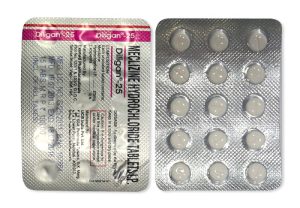
Packs vary quite a bit between countries, and some products are sourced internationally rather than in standard Australian retail packaging.
| Form | Common Strengths | Typical Packaging | Region |
|---|---|---|---|
| Tablets | 12.5 mg, 25 mg, 50 mg | Bottles of 100 | USA, EU, Asia |
| Chewable tablets | 25 mg | Blister pack of 8 or bottle of 100 | USA, Canada |
| Caplets | 25 mg | Blister pack or bottle | Asia, Latin America |
Legal Status, TGA Oversight, And PBS Realities
TGA Approval And Australian Availability
Australian availability can vary depending on whether the product is stocked as a registered medicine or brought in as an imported equivalent.
The TGA is the regulator patients should rely on for medicine safety and legality.
Some meclizine products are OTC in some countries, especially for motion sickness at lower doses, while others are prescription-only depending on the indication and jurisdiction.
Pbs Subsidy And Price Sensitivity
Australian patients are often very price-conscious, especially for travel sickness tablets bought before school holidays or a long weekend.
PBS subsidy status may not be straightforward and may not apply to every meclizine product or brand.
- Check whether a prescription is required.
- Confirm the pack strength and dose form.
- Ask whether an equivalent product is subsidised.
- Use pharmacist counselling and national medicines information sources before buying.
What Antivert Is Used For
Approved And Common Uses
Antivert is used for motion sickness and for vertigo or dizziness related to vestibular conditions.
Product information gives adult dosing for motion sickness as 25 to 50 mg one hour before travel, repeated every 24 hours if needed.
For vertigo, the adult dose is 25 to 100 mg daily in divided doses.
It is not a medicine for every kind of nausea, especially not ordinary stomach bugs or acute gastro symptoms.
When It Is Not The Right Medicine
Depending on the symptom pattern, other Australian options may suit better, including hyoscine hydrobromide, dimenhydrinate, cyclizine, prochlorperazine, or betahistine for some vestibular disorders.
- Best suited to motion sickness, vestibular vertigo, and nausea linked to balance problems.
- Less suitable for general stomach infections, food poisoning, or nausea without a vestibular cause.
- Off-label use can carry the wrong side-effect burden if the cause of symptoms has not been identified.
Micro-FAQ — Is It For Ordinary Nausea?
Usually no, unless the nausea is linked to motion sickness or a vestibular cause.
How Meclizine Works
Simple Explanation For Patients
Meclizine blocks histamine H1 receptors and has antivertigo and antiemetic effects.
In plain English, it helps calm the brain’s response to motion-triggered dizziness and nausea.
That is why it is used as a motion sickness medication and as a vertigo treatment Australia patients may ask about in pharmacy or online.
Clinical Wording
The ATC code is N07CA03, and the product data classifies it as an antiemetic and antivertigo drug, a histamine H1 antagonist.
Its sedating and anticholinergic effects help explain why drowsiness and dry mouth can happen.
- Histamine
- A chemical messenger involved in allergy, wakefulness, and some balance pathways.
- Vestibular
- Related to the inner ear balance system.
- Anticholinergic
- A medicine effect that can cause dry mouth, blurred vision, and urinary retention.
Standard Dosing And How To Take It Safely
Adult Doses For Travel Sickness And Vertigo
Tablets commonly come in 12.5 mg, 25 mg, and 50 mg strengths.
| Indication | Adult Dose | How To Take It |
|---|---|---|
| Motion sickness | 25 to 50 mg | Take 1 hour before travel; repeat every 24 hours if needed |
| Vertigo | 25 to 100 mg daily | Use divided doses |
Dose Adjustments And Special Populations
Children under 12 years are not recommended to use it, and the product information states they are contraindicated.
Older adults should use the lowest effective dose and be watched for sedation and anticholinergic effects.
There are no formal renal or hepatic adjustment guidelines in the data, so clinical judgement is needed when kidney or liver impairment is present.
- Check the dose strength before swallowing.
- Take the medicine before travel if using it for motion sickness.
- Avoid accidental double dosing if symptoms persist.
- Use caution if another medicine already causes drowsiness.
Micro-FAQ — What If I Miss A Dose?
Take it when remembered unless the next dose is close.
Do not double up.
Severe drowsiness, seizures, or signs of anticholinergic toxicity need emergency care.
Side Effects And When To Get Help
Common Side Effects
The most common effects are drowsiness, dry mouth, headache, and blurred vision.
Sedation, confusion, and urinary retention can occur too, especially in older adults.
Falls and cognitive impairment are more likely in elderly patients, so that group needs close attention.
| Effect | How Often It Matters Clinically | What To Do |
|---|---|---|
| Drowsiness, dry mouth, headache, blurred vision | Common | Rest, avoid alcohol, and monitor symptoms |
| Sedation, confusion, urinary retention | Less common but important | Speak with a pharmacist or GP |
| Severe sleepiness, inability to wake properly, allergic reaction, fainting | Urgent | Seek emergency care now |
Red Flags That Need Urgent Review
Severe sleepiness, inability to wake properly, severe confusion, trouble urinating, fainting, or any sign of allergic reaction should not be ignored.
If side effects interfere with driving or work, a pharmacist at Chemist Warehouse, Priceline, TerryWhite Chemmart, or a GP can help decide whether a different medicine is safer.
- Mild: dry mouth, headache, blurred vision, light sedation.
- Needs review: confusion, urinary retention, ongoing drowsiness.
- Seek help now: severe confusion, collapse, allergic reaction, or overdose concerns.
Interactions With Food, Drink, And Other Medicines
Alcohol And Everyday Substances
Alcohol can increase sedation and impair judgment, so it is best avoided.
Caffeine will not cancel out the sedative effect, even on a long haul drive, a camping trip, a ferry ride, or a daily public transport commute.
That matters for people buying travel sickness tablets or motion sickness tablets Australia travellers often grab at the last minute.
Common Medicine Conflicts
Extra drowsiness can happen with other antihistamines, sleep medicines, benzodiazepines, opioids, and some antidepressants.
Medicines that worsen dry mouth, blurred vision, or urinary retention need careful checking as well.
| Substance Or Medicine Group | Risk | What To Do |
|---|---|---|
| Alcohol | More sedation and poorer judgment | Avoid while taking meclizine |
| Other antihistamines, sleep medicines, benzodiazepines, opioids | Additive drowsiness and impaired reaction time | Check with a pharmacist first |
| Medicines that worsen dry mouth, blurred vision, or urinary retention | Anticholinergic effects may stack | Get individual advice |
Who Should Be Extra Cautious
High-Risk Groups
Older adults, people with glaucoma, asthma or breathing problems, urinary retention or prostate enlargement, liver or kidney impairment, and anyone with a history of falls need extra caution.
Product data specifically warns that older adults are at risk of sedation, falls, and cognitive impairment, so the lowest effective dose matters.
Pregnancy And Breastfeeding
Pregnancy and breastfeeding should be discussed with a doctor or pharmacist because a benefit-risk assessment may be needed.
Blanket reassurance is not the right approach here, especially if symptoms are recurrent or the patient is already taking other medicines.
- Benefit-risk assessment
- A clinical decision about whether the likely benefit outweighs the possible risk.
- Falls risk
- The chance of slipping, stumbling, or being unsteady after taking a sedating medicine.
- Anticholinergic effects
- Effects such as dry mouth, blurred vision, constipation, and urinary retention.
- Ask a pharmacist before starting if the patient is older.
- Ask before use if glaucoma or urinary retention is present.
- Ask if pregnancy, breastfeeding, or liver or kidney impairment is part of the history.
Access In Australia: Where Patients Actually Get It
Pharmacy Chains And Local Access
Common Australian access points include Chemist Warehouse, Priceline, TerryWhite Chemmart, independent pharmacies, and rural pharmacies.
Metro areas usually have broader stock, while regional and remote patients may need ordering or substitution advice.
That is where pharmacists are especially useful, because they can help match the right dose and the right pack to the symptoms.
Online Pharmacies And Telehealth E-Prescriptions
Online pharmacies and telehealth can improve access, especially when a prescription is needed.
Using legitimate Australian pharmacies matters, particularly for medicines that may be regulated differently overseas.
In our online pharmacy, antivert is available without a prescription, with discreet delivery to Australia in 9 to 21 days.
| Access Option | What It Suits | Practical Notes |
|---|---|---|
| In-store pharmacy | Quick advice and same-day purchase where stocked | Useful for urgent travel plans |
| Online pharmacy | Convenience and discreet ordering | Check the legitimacy of the pharmacy |
| Telehealth and e-prescriptions | When a script is needed | Helpful for regional or time-poor patients |
- Confirm whether the medicine is registered or imported.
- Use a legitimate Australian pharmacy.
- Check delivery times before travel.
- Ask about substitution if stock is limited.
Price, Pbs, And Consumer Decision-Making
What Affects The Cost
Price varies by brand, pack size, import status, and whether a prescription is required.
PBS subsidy may not apply to every meclizine product, so patients should confirm before assuming any discount pricing.
Comparison Snapshot
| Source | Typical Price Range | Prescription Required | PBS Status |
|---|---|---|---|
| Major pharmacy chains | Varies by pack and brand | Sometimes | Check current listing |
| Independent pharmacies | Varies by local supply | Sometimes | Check current listing |
| Online pharmacies | Often competitive | Sometimes | Check current listing |
- Compare the same strength, not just the brand name.
- Factor in delivery time if travel is coming up soon.
- Ask a pharmacist if a generic equivalent is suitable.
Alternatives And When They May Be Better
Comparison With Other Vertigo And Travel-Sickness Medicines
The best option depends on whether the problem is motion sickness, vestibular vertigo, or another cause of nausea.
| Medicine | Main Use | Sedation Level | Typical Access In Australia |
|---|---|---|---|
| Meclizine | Motion sickness, vertigo | Can be sedating | Varies by supply and regulation |
| Dimenhydrinate | Travel sickness tablets, nausea | Often sedating | Commonly discussed in pharmacy |
| Cyclizine | Motion sickness, nausea | Sedating | Available in some settings |
| Promethazine | Nausea, allergy-related uses | More sedating | Often prescription-based |
| Hyoscine hydrobromide | Motion sickness prevention | Can be sedating | Common travel option, including Kwells |
| Betahistine | Vestibular disorders | Usually less sedating | Prescription medicine |
| Prochlorperazine | Dizziness and nausea | Can be sedating | Prescription medicine |
Choosing The Right Option
A pharmacist can help decide between vertigo medication Australia patients may hear about, and the choice often comes down to the cause of symptoms and how much sedation is acceptable.
Dimenhydrinate tablets Australia and related dimenhydrinate combination products may suit some people better for travel, while betahistine may be more relevant for certain vestibular disorders.
- Meclizine: useful for motion sickness and some vertigo, but can cause drowsiness.
- Dimenhydrinate: often chosen for travel sickness, but sedation is common.
- Hyoscine hydrobromide: useful for prevention of motion sickness, especially before travel.
- Betahistine: considered when vestibular symptoms are the main issue.
- Prochlorperazine: may help nausea and dizziness, but needs prescription-style counselling.
What The Evidence Says
Clinical Usefulness
Meclizine has an established place in motion sickness and vestibular symptom relief.
The main evidence-based value is symptom control, not curing the underlying cause of vertigo.
Research And Real-World Use
The product data also mentions ongoing research in neuro-inflammation and migraine prevention, but these are not routine Australian indications.
- Good for symptom relief in motion sickness and vestibular problems.
- Not a cure for the underlying balance disorder.
- Diagnosis and ongoing symptoms should guide treatment choices.
Storage, Handling, And Travelling With It
At-Home Storage In Australian Conditions
Store at room temperature, between 20 and 25 degrees Celsius, and protect from moisture and heat.
Australia’s hot climate makes it sensible to keep it out of cars, windowsills, and bathrooms.
Travelling And Pack Safety
Carry it in the original packaging when flying or road-tripping, and keep it away from excessive heat.
Freezing is not recommended.
- Do store in original packaging.
- Do keep away from heat and moisture.
- Do check expiry before travel.
- Do not leave it in a parked car.
Patient Counselling Points And Proper Use
What Australian Pharmacists Usually Tell Patients
Take it before travel if it is being used for motion sickness.
Use the lowest effective dose.
Avoid alcohol.
Do not drive if drowsy.
Seek help if symptoms persist or worsen.
Pharmacists are a high-trust first point of contact in Australia, especially when the patient is comparing travel sickness tablets, motion sickness tablets Australia, or vertigo treatment Australia options.
When To Escalate To A GP Or Emergency Care
Persistent vertigo, new neurological symptoms, repeated vomiting, dehydration, severe confusion, overdose concerns, or symptoms that do not fit a vestibular cause need medical review.
- Seek pharmacy advice for product selection, dose checks, and side-effect questions.
- Seek GP review for ongoing vertigo, chronic symptoms, pregnancy, breastfeeding, or complex medicine lists.
- Seek emergency care for overdose, severe confusion, seizures, collapse, or allergic reaction.
Micro-FAQ — Can I Use It Every Day?
Daily use should be individualised, especially for chronic vertigo.
Long-term use should be reviewed by a clinician rather than continued without a check-in.
Delivery Across Australia
| City | Region | Delivery Time |
|---|---|---|
| Sydney | New South Wales | 9-14 days |
| Melbourne | Victoria | 9-14 days |
| Brisbane | Queensland | 9-14 days |
| Perth | Western Australia | 9-14 days |
| Adelaide | South Australia | 9-14 days |
| Canberra | Australian Capital Territory | 9-14 days |
| Hobart | Tasmania | 9-14 days |
| Darwin | Northern Territory | 9-14 days |
| Gold Coast | Queensland | 9-14 days |
| Newcastle | New South Wales | 9-14 days |
| Wollongong | New South Wales | 14-21 days |
| Geelong | Victoria | 14-21 days |
| Cairns | Queensland | 14-21 days |
| Townsville | Queensland | 14-21 days |
| Albury | New South Wales | 14-21 days |