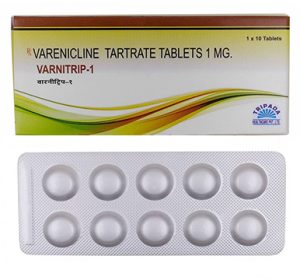
Varenicline

In stock
0.5mg · 1mg
from A$133.59
In brief
- Varenicline is usually supplied in pharmacies and online pharmacies worldwide; it is legally prescription-only in Australia and most countries, though availability varies and some pharmacies or online sellers may supply it without a receipt — you should obtain it with a valid prescription and medical supervision.
- Varenicline is used for smoking cessation; it is a partial agonist at α4β2 nicotinic acetylcholine receptors, which reduces cravings and withdrawal symptoms while diminishing the rewarding effects of nicotine.
- The usual dosing starts 0.5 mg once daily for days 1–3, then 0.5 mg twice daily for days 4–7, then 1 mg twice daily from day 8, with a standard treatment course of 12 weeks (may be extended to 24 weeks in selected patients); renal impairment requires dose reduction.
- It is administered orally as film-coated tablets, commonly 0.5 mg and 1 mg strengths in blister packs.
- Varenicline begins to reduce cravings and withdrawal within days of starting treatment, with many patients noticing benefit within 1–2 weeks once titration reaches the therapeutic dose.
- Its duration of clinical effect supports twice-daily dosing, with an effective duration approximating 24 hours per dose; treatment courses are measured in weeks.
- Avoid excessive alcohol while taking varenicline and monitor for changes in mood or behaviour; alcohol may worsen neuropsychiatric side effects and increase risk-taking or unusual behaviours.
- The most common side effect is nausea; other frequent effects include insomnia, abnormal dreams, headache and gastrointestinal symptoms (constipation, gas, vomiting), and mild mood changes.
- Would you like to try “varenicline” without a prescription?
Basic Varenicline Information
- INN (International Nonproprietary Name): Varenicline (varenicline tartrate).
- Brand Names Available In Australia: Marketed in Australia as Champix (film‑coated tablets 0.5 mg and 1 mg); generic varenicline may be available — verify with local pharmacy stock.
- ATC Code: N07BA03 — Drugs Used In Nicotine Dependence (varenicline).
- Forms & Dosages: Film‑coated tablets 0.5 mg and 1 mg; common blister packs (starter/titration packs and 42–56 tablet packs).
- Manufacturers In Australia: Original developer Pfizer (Champix); various generics manufacturers supply varenicline where authorised — check local registers for current suppliers.
- Registration Status In Australia: Champix is registered and authorised for prescription use in Australia (authority prescription only).
- OTC / Rx Classification: Prescription Only (Rx). Varenicline is not available over the counter and requires medical supervision.
Critical Warnings & Restrictions — Patient Protection First
High‑Risk Groups (Elderly, Pregnancy, Chronic Illness)
Who Needs Extra Care?
Patients with a history of psychiatric illness, those with serious cardiovascular disease, pregnant or breastfeeding people, and older adults with comorbidities need closer monitoring.
Relative Contraindications: history of psychiatric illness; serious cardiovascular disease; pregnancy and breastfeeding not recommended.
Absolute Contraindications: known hypersensitivity to varenicline or excipients, history of severe cutaneous adverse reactions, and use in children (not indicated).
Renal Impairment Dosing Limits: Moderate renal impairment — max 1 mg/day; Severe renal impairment (CrCl <30 ml/min) — max 0.5 mg/day.
Baseline Assessment Recommend: mental‑health history, current medicines, renal function, pregnancy test where relevant, and counselling on suicide/self‑harm warning signs.
- Screening Checklist:
- Collect mental‑health history including depression, suicidal ideation and current psychiatric treatment.
- Ask about current medicines including antidepressants, antipsychotics, anticonvulsants and sedatives.
- Check renal function (eGFR/CrCl) and note any nephrotoxic co‑medication.
- Confirm pregnancy status or breastfeeding; advise against use if pregnant or breastfeeding.
- Record known drug allergies and history of severe skin reactions.
- Checklist For Monitoring (Weekly First Month):
- Week 1: review nausea, sleep patterns and mood changes; confirm renal dosing if needed.
- Week 2: check adherence, intensity of vivid dreams or insomnia, and any mood or behaviour changes.
- Week 3: reassess nausea and gastrointestinal tolerance; screen again for suicidal ideation if any mood symptoms.
- Week 4: evaluate effectiveness on cravings and overall tolerability; plan ongoing follow‑up.
- Short Decision Flowchart For Stopping Treatment:
- If severe rash, blistering or Stevens‑Johnson symptoms occur → stop immediately and seek urgent medical review; report to TGA.
- If new or worsening suicidal thoughts, severe behavioural changes, or psychosis → stop immediately and arrange urgent psychiatric assessment; report to TGA.
- If severe cardiac symptoms (chest pain, syncope or worsening heart failure) in high‑risk patients → stop and arrange urgent cardiology/ED assessment; report to TGA.
- If intolerable persistent nausea or vomiting despite mitigation → consider dose adjustment or discontinuation after GP review.
Report suspected adverse events to the Therapeutic Goods Administration (TGA) — patients and pharmacists can submit reports via the TGA website.
Interaction With Activities (Driving, Workplace Safety Under Australian Law)
Does treatment affect day‑to‑day tasks such as driving or operating machinery?
Common side effects include nausea, insomnia, abnormal dreams and headache; mild mood changes are possible.
Rare neuropsychiatric effects (behavioural changes, suicidal ideation) have been reported and require immediate attention.
Safety‑critical roles (drivers, heavy machinery operators, pilots) should take particular care and discuss treatment with their clinician or occupational health adviser.
First doses should ideally be taken at home where the person can monitor for dizziness, marked drowsiness or severe nausea before returning to safety‑critical duties.
Notify an employer or occupational health service if duties may be affected and document any adverse effects in workplace health assessments.
Q&A — “Can I Drive After Taking It In Australia?”
Q: Can I drive after taking varenicline?
A: Most people can drive, but if you experience dizziness, severe nausea, marked sleep disturbance or any mood or behavioural change do not drive and seek medical advice.
Document these risks in workplace assessments and notify your GP or pharmacist if duties are affected.
Usage Basics
INN, Brand Names Available In Australia
International Nonproprietary Name (INN): varenicline (varenicline tartrate).
In Australia it is marketed as Champix in film‑coated 0.5 mg and 1 mg tablets, usually in starter blisters and multi‑pack formats.
Generic varenicline preparations may be available; always verify exact pack and formulation with your pharmacy.
Legal Classification (TGA‑Approved, PBS Considerations)
Varenicline is TGA‑approved as a prescription‑only medicine for smoking cessation.
PBS listing and special authority eligibility may change; check the PBS website before claiming any subsidy.
Many patients pay privately or use private scripts; telehealth e‑prescriptions are accepted by Australian pharmacies.
Quick Reference:
- INN: Varenicline (varenicline tartrate).
- Brand: Champix (Australia).
- ATC: N07BA03.
- Legal Status: Prescription Only (TGA).
Dosing Guide
Standard Regimens (PBS Reference Dosing)
The standard adult titration for smoking cessation is:
- Days 1–3: 0.5 mg once daily.
- Days 4–7: 0.5 mg twice daily.
- Day 8 onward: 1 mg twice daily.
Recommended treatment duration is 12 weeks, with the option to extend to 24 weeks in selected patients who are abstinent at week 12.
The Defined Daily Dose (DDD) for varenicline is 2 mg orally.
Adjustments For Comorbidities
Elderly patients do not require routine dose reduction unless renal impairment is present; monitor tolerability.
Varenicline is not indicated in children.
| Patient Group | Recommended Dose |
|---|---|
| Normal renal function/adult | 0.5 mg days 1–3; 0.5 mg twice daily days 4–7; 1 mg twice daily day 8 onward |
| Moderate renal impairment | Maximum 1 mg/day (adjust regimen with GP guidance) |
| Severe renal impairment (CrCl <30 ml/min) | Maximum 0.5 mg/day |
| Children | Not indicated |
Q&A — “What If I Miss A Dose?”
Q: What if I miss a dose of varenicline?
A: Take the missed dose as soon as you remember unless it is close to the next scheduled dose; do not double up.
If multiple doses are missed contact your pharmacist or GP for advice on restarting the schedule.
Interaction Chart
Food And Drinks (Alcohol, Coffee, Australian Diet Context)
No major food interactions are documented with varenicline.
Alcohol may exacerbate mood changes and can make stopping smoking harder; advise moderation while on treatment.
Caffeine late in the day can worsen insomnia or vivid dreams for people who experience sleep disturbance.
- Practical Tips:
- Reduce late‑night alcohol and caffeine while titrating and during treatment.
- Avoid heavy meals at bedtime to help reduce nausea and sleep disruption.
- If drinking alcohol triggers mood changes or relapse risk, seek additional support from Quitline or GP.
Common Drug Conflicts
Varenicline has few pharmacokinetic drug–drug interactions, but additive CNS effects are possible.
Use care with medications that affect mood or cognition, and with drugs cleared renally if the patient has impaired renal function.
| Concomitant Drug | Practical Advice |
|---|---|
| SSRIs/Other Antidepressants | Monitor mood and suicidal ideation; continue psychiatric follow‑up. |
| Benzodiazepines/Sedatives | Monitor for increased sedation or impaired alertness; caution with driving. |
| Antipsychotics | Monitor behavioural changes; liaise with mental health prescriber. |
| Alcohol | May worsen neuropsychiatric symptoms and lower quit success; advise moderation. |
| Nephrotoxic Drugs | Check renal function and adjust varenicline dose if renal impairment is present. |
Use a medicines reconciliation checklist at every supply to check for new CNS medicines, mood stabilisers, or renal risk drugs.
User Reports & Trends (Australian Patient Feedback)
Where does real feedback come from?
Sources include ProductReview, national health forums, pharmacy call logs and telehealth feedback.
- Common Pros From Reviews:
- Many report a strong reduction in cravings within 1–2 weeks.
- Improved ability to decline cigarettes when cravings occur.
- Common Cons From Reviews:
- Nausea is the most commonly reported adverse effect and is often dose‑related.
- Insomnia and vivid or abnormal dreams lead some to stop treatment.
- Persistent nausea is the main reason for discontinuation in consumer reports.
| Sentiment | Notes |
|---|---|
| Positive | Rapid craving reduction; many achieve abstinence by 12 weeks. |
| Negative | Nausea, sleep disturbance, cost and stock issues in some areas. |
| Neutral | Mixed reports about combining with counselling and NRT effectiveness. |
Trends since COVID‑19: telehealth prescriptions and online supply have increased, improving urban access but rural patients can face stock variability and higher out‑of‑pocket costs.
Moderation: corroborate anecdotes with clinical guidance and TGA product information when counselling patients.
Access & Purchase Options (Australia)
National Chains (Chemist Warehouse, Priceline, TerryWhite Chemmart)
Large pharmacy chains commonly stock Champix and generic varenicline; prices and availability vary by store.
Bring your prescription or use an accepted telehealth e‑script when collecting from these stores.
- Checklist For Buying Locally:
- Bring the prescription or have your e‑script ready.
- Discuss side effects and renal dosing with the pharmacist before supply.
- Ask if PBS subsidy applies or if generics are available to reduce cost.
Online Pharmacies And Telehealth E‑Prescriptions
Australian online pharmacies and telehealth providers can supply varenicline with a valid prescription; ensure the pharmacy is TGA‑registered and uses secure e‑prescriptions.
For rural patients consider mail order but factor in delivery time and heat exposure during transit.
In our online pharmacy, varenicline is available without a prescription, with discreet delivery to Australia in 9‑21 days.
- Checklist For Safe Online Purchase:
- Verify the pharmacy is Australian‑registered and TGA‑compliant.
- Use secure e‑prescriptions or present a valid paper prescription.
- Avoid international unregulated sources and unverified marketplaces.
- Ask about insulated packaging for summer delivery to avoid heat damage.
Mechanism & Pharmacology
Simplified Explanation
Varenicline is a nicotinic acetylcholine receptor partial agonist that reduces cravings and withdrawal while blocking nicotine’s rewarding effects.
It is the first approved nicotinic receptor partial agonist for smoking cessation and works specifically at α4β2 receptors to blunt nicotine‑driven dopamine release.
Clinical Terms (For Clinicians)
Pharmacodynamics: Partial agonist at α4β2 nicotinic receptors; reduces nicotine reward and diminishes withdrawal symptoms.
Pharmacokinetics: Oral bioavailability sufficient for systemic effects and primarily excreted unchanged by the kidney — hence renal dosing adjustments are required for CrCl <30 ml/min.
Defined Daily Dose: 2 mg orally (ATC/DDD system).
- Definitions For Patient Brochures:
- Partial Agonist — activates the receptor partly while blocking stronger stimulation from nicotine.
- DDD — a standardised average dose for comparison across populations (2 mg for varenicline).
- CrCl — creatinine clearance, used to assess renal function and guide dosing.
Compact Schematic For Patients: Varenicline = Less Craving. Less Reward = Easier To Quit.
Indications & Off‑Label Uses
Approved Indications By TGA
Primary indication: smoking cessation in adults; standard short‑term course is 12 weeks with an option to extend to 24 weeks for selected patients who are abstinent.
Legal status: prescription only and TGA‑approved for this indication.
Off‑Label Uses In Australian Clinical Practice
Some trials have explored varenicline for vaping cessation, other tobacco products and reducing alcohol cue reactivity, but routine off‑label use should be specialist‑led.
| Off‑Label Area | Evidence Strength |
|---|---|
| Vaping cessation/reduction | Low to moderate — emerging studies |
| Other tobacco product dependence | Low — limited trial data |
| Alcohol cue reactivity reduction | Low — investigational |
When prescribing off‑label, document rationale, obtain informed consent and monitor adverse events closely.
Key Clinical Findings (Evidence Summary 2022–2026)
What Does The Evidence Say?
- Multiple randomised controlled trials and meta‑analyses show varenicline is more effective than placebo and often superior to single‑form NRT or bupropion for sustained abstinence at 6–12 months.
- Recent trials to 2026 support extending therapy to 24 weeks for selected responders to improve long‑term abstinence rates.
- Safety data confirm common adverse events of nausea, sleep disturbance and abnormal dreams; rare but serious neuropsychiatric events require vigilance.
- Cardiovascular safety is monitored in high‑risk patients; clinicians should follow the latest systematic reviews and local guidelines.
Clinicians should consult Cochrane reviews, TGA safety updates and major peer‑reviewed trials for primary data when advising patients.
Alternatives Matrix
PBS‑Listed Alternatives Comparison Table
| Agent | Mechanism | Typical Efficacy | Common Side Effects | PBS Status |
|---|---|---|---|---|
| Bupropion (Zyban) | Norepinephrine/dopamine reuptake inhibitor | Moderate | Insomnia, dry mouth, seizure risk | Rx; PBS listing varies |
| NRT (Patch, Gum, Lozenge) | Nicotine replacement | Moderate | Local irritation, sleep disturbance | OTC; some forms PBS‑listed or subsidised in programs |
| Cytisine | Plant alkaloid partial agonist | Low‑moderate | Nausea, sleep changes | Off‑label/import in Australia |
Pros And Cons Checklist
- Bupropion: check seizure risk, psychiatric history and possible PBS eligibility.
- NRT: easy access OTC, useful for pregnancy with GP advice, lower immediate cost in some cases.
- Cytisine: lower price where available but less widely authorised — consider specialist advice.
Common Questions (Australian Pharmacy FAQs)
- Can I use varenicline while breastfeeding? — Not recommended; advise discussion with GP about alternatives.
- Can I combine varenicline with NRT? — Combination is sometimes used under supervision; check with your GP or pharmacist.
- How long before I quit should I start? — Begin the titration 1 week before your planned quit date; follow GP guidance.
- What if I experience severe nausea? — See your GP or pharmacist; taking with food or adjusting timing can help and antiemetic advice may be appropriate.
- Is varenicline safe for older adults? — Yes with monitoring and renal dose adjustment if impairment is present.
- What should I do about vivid dreams? — Report to your pharmacist; if disturbing, a dose timing change or temporary pause may be considered.
- How do I report a serious side effect? — Report to the TGA and inform your treating clinician.
- Where can I get help quitting? — Contact 13QUIT or your state Quitline service for counselling and support.
Price & Access Comparison Table
| Pharmacy/Source | Typical Price Range | PBS Subsidy | Prescription Required |
|---|---|---|---|
| Chemist Warehouse | Varies by pack and brand | Check PBS | Yes |
| Priceline | Varies by pack and brand | Check PBS | Yes |
| TerryWhite Chemmart | Varies by pack and brand | Check PBS | Yes |
| Online Australian Pharmacy | Varies; may include shipping | Check PBS | Yes (e‑script accepted) |
| GP Clinic (dispensed) | Varies | Check PBS | Yes |
- Access Checklist: check local stock, ask pharmacist about generics, consider mail order with insulated packaging for summer, ask about partial supply options if cost is an issue.
Registration & Regulation (Australia Focus)
TGA Approval
Varenicline is a prescription medicine approved by the TGA for smoking cessation and marketed as Champix and generics where authorised.
Pharmacovigilance obligations include reporting serious adverse events to the TGA.
PBS Subsidy Details
PBS coverage can change; clinicians and patients should check the PBS Schedule and local state schemes for current subsidy details.
Where PBS listing exists special authority restrictions may apply; otherwise the treatment is private‑prescription.
- Definitions: TGA Approval — regulatory authorisation for use; PBS Subsidy — government subsidy for cost; Special Authority — extra approval rules that may apply.
Storage & Handling
Household Storage In Australian Climate (Heat/Humidity)
Store below 25°C and protect from moisture.
Keep tablets in the original packaging until use and avoid leaving them in hot cars or exposed to direct sunlight.
For summer mail order request insulated packaging and avoid prolonged postal delays in high temperatures.
Keep out of reach of children.
Cold‑Chain Handling For Pharmacies
Varenicline is not a cold‑chain medicine but should be stored at controlled ambient temperature and not in hot dispensary windows or fridges.
Counsel patients about avoiding heat exposure during transport, such as leaving packs in a closed car in summer.
- Pharmacy Checklist: maintain ambient storage below 25°C, rotate stock, advise patients on transport and storage at point of supply.
Guidelines For Proper Use — Pharmacist Counselling & Patient Advice
Australian Pharmacist Counselling Style
Start by asking why the patient wants to quit and set a quit date.
Review mental‑health history, current medicines and renal function before supply.
Explain the titration schedule clearly and counsel about common side effects such as nausea, vivid dreams and insomnia.
Advise when to stop and seek urgent help for suicidal ideation, severe rash or cardiac symptoms.
Document informed consent and set a follow‑up plan with 1–2 phone check‑ins during the first month.
- Counselling Checklist:
- Screening and baseline checks.
- Explain dosing and titration.
- Side‑effect mitigation strategies (food, timing, antiemetic options).
- Emergency signs and referral pathways.
Patient Advice From PBS And National Health Authorities
Signpost Quitline (13QUIT) and state Quitline services for behavioural support and counselling.
Encourage combination of pharmacotherapy with structured behavioural support for best outcomes.
Advise patients to report adverse events to the TGA and to keep a medicine diary documenting doses and side effects.
- Printable Patient Checklist:
- When to call GP: severe nausea, persistent vomiting, new suicidal thoughts, severe rash.
- When to stop: severe skin reaction or marked behavioural change.
- How to store: below 25°C in original pack.
- How to report: contact TGA online and inform your prescriber.
Follow‑Up Schedule Template For Pharmacists: phone at day 3, day 14 and week 4; in‑person or telehealth check at week 12 or if problems arise.
Delivery Across Australia
| City | Region | Delivery Time |
|---|---|---|
| Sydney | New South Wales | 9‑14 days |
| Melbourne | Victoria | 9‑14 days |
| Brisbane | Queensland | 9‑14 days |
| Perth | Western Australia | 9‑14 days |
| Adelaide | South Australia | 9‑14 days |
| Hobart | Tasmania | 9‑14 days |
| Darwin | Northern Territory | 9‑14 days |
| Canberra | Australian Capital Territory | 9‑14 days |
| Gold Coast | Queensland | 9‑14 days |
| Newcastle | New South Wales | 14‑21 days |
| Wollongong | New South Wales | 14‑21 days |
| Cairns | Queensland | 14‑21 days |
| Townsville | Queensland | 14‑21 days |
Delivery times are indicative and depend on courier services, local availability and seasonal conditions.